You are five minutes from watching a language model decide, live: the words it chose, the words it set aside, and the thinking it kept private. Drawn as it happens, from the model's own numbers, free in your browser.
Open the observatory"Write a two-line poem about the sea."
Sixteen words come back, and this is the decision behind them.
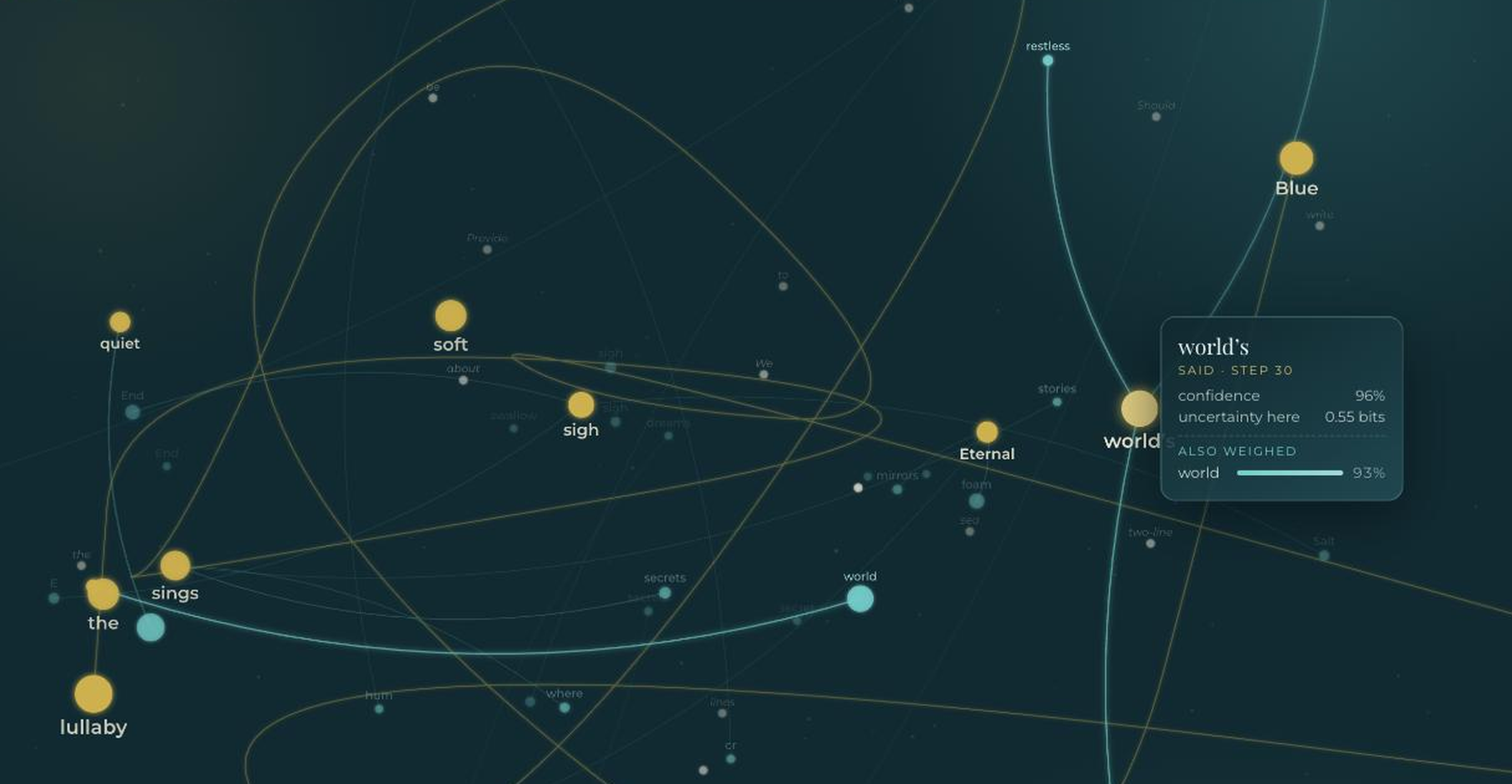
At step thirty it chose world's with 96 per cent confidence, and world was sitting right behind it at 93. That turquoise thread is the poem that almost happened.
Ask it "what is 47 times 23" and something else appears. Faint cream words drift across the dark first. 40*23=920. 7*23=161. sum=1081. Then a single gold star arrives: 1081.
The model did long multiplication in private, and you just read its working.
In 2025, Anthropic researchers found exactly this happening inside Claude: hidden intermediate steps, readable as words, appearing before any answer. They named the place they found them the J-space. This instrument is named for that discovery.
The arithmetic is the party trick. The forks are the real story.
Gold is what it said. Every word sized by the exact probability the model gave it. Calm, bright words were near-certain. Small, flickering ones were close calls.
Turquoise is what it set aside. At every step the model weighs thousands of possible next words. The strongest rivals appear, joined by a thread to the fork where they lost. Hover a gold word and the sentence that could have happened lights up.
Cream is the inner voice. Some models reason in private text before they answer. The ideas inside that hidden stream surface first, the way the arithmetic did.
Underneath sits a strip that measures uncertainty word by word, in bits. Tall bars are the moments the answer genuinely could have gone another way. Drag the timeline and you can replay the whole decision from the first fork to the last.
Everyone repeats the same line about AI: it is a black box, and nobody can see what it is thinking.
You have probably said it yourself. I did too.
So you take its answers on faith. At work. In your research. In advice you act on.
And when a model is confidently wrong, which every model sometimes is, the confidence and the wrongness look identical on the page. There is no way to tell which sentence deserved your doubt.
Here is what the black box story leaves out.
With every single word a model writes, it reports numbers about itself. How sure it was. Which words nearly came out instead. For some models, whole thoughts it worked through in private before speaking.
Those numbers stream past unread, millions of times a day.
Read them, and every answer becomes a path you can walk back, fork by fork.
Every position on the map is earned. A separate embedding model turns each word into 2,048 numbers of meaning. A theorem from 1984 compresses them while keeping their distances honest. The map then spreads this conversation along its two widest directions, so words that mean similar things sit near each other, and the gold thread traces the order the model walked through them.
The blind spots are named too. Attention, activations, and the true J-space live inside a model's weights, and reading those takes a research lab. What you see here is the closest public shadow, rebuilt from what the model reports about itself while it writes to you.
J-Space is part of Her Frontier, where women learn to read, run and build AI on their own terms. Seeing a machine decide is the fastest cure for being intimidated by one.
Open the observatory, ask anything you like, and read the answer the way the model wrote it: one fork at a time.
Open the observatory